The silent witness effect — why a stranger on your screen gets you to start what willpower can't
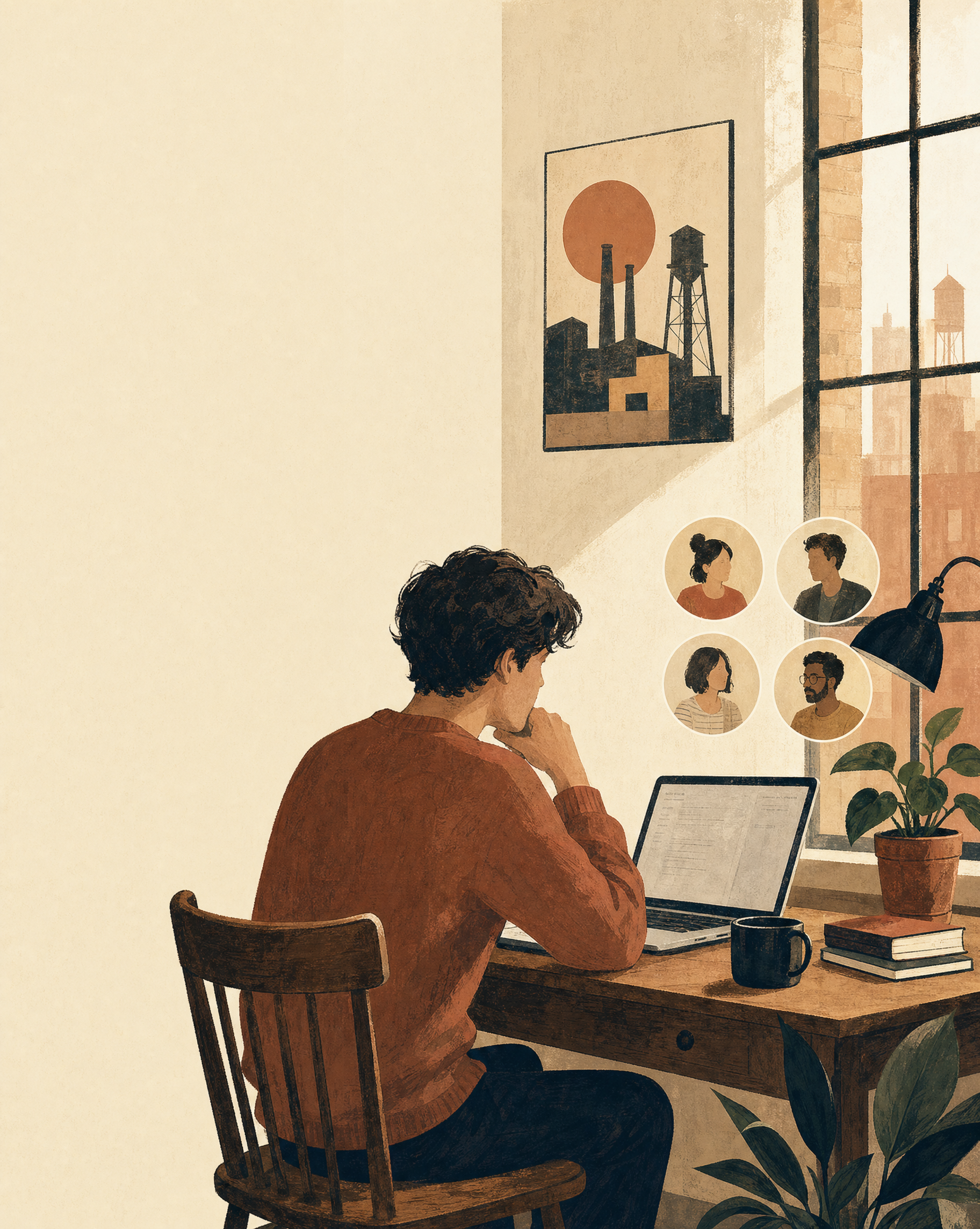
There’s a task on your list. You’ve moved it forward four times this week. You know how to do it. It is not difficult. You will probably finish it in twenty minutes once you start.
You are not going to start it today.
If you’ve ever tried to talk yourself into beginning a piece of work you know how to do, you’ve felt this. The shame layer arrives within minutes — why can’t I just open the document? — and the shame doesn’t help, it just makes the cost of opening the document a little higher, because now opening it would also mean admitting how long you’ve been not opening it.
This essay is about a mechanism that solves this, and about the fact that the mechanism is older than the technology that delivers it by a hundred years.
A factory near Chicago, 1924
The Western Electric Hawthorne Works manufactured telephone equipment for Bell. In 1924 the company commissioned a series of experiments to figure out what level of factory lighting would make assembly-line workers most productive. The hypothesis was simple. Better lighting, faster work.
They turned the lights up. Productivity rose. They turned them down. Productivity rose. They moved the breaks earlier, then later. Productivity rose. They changed the schedule, the wages, the seating arrangements. Productivity kept rising. After two years of experiments, the researchers realised the variable they were testing was never the actual variable.
The actual variable was that somebody was watching.
A clerk had been stationed in the test rooms to record output. The workers had been told the experiments were happening. The lighting wasn’t doing the work. The clerk was. Two years of intervention proved that the mere awareness of being observed changed how human beings behaved at their workstations, regardless of what the observation was for.
This became known as the Hawthorne Effect, and over the following century it grew into one of the most replicated findings in the social sciences. By 1965 the social psychologist Robert Zajonc had formalised it into what we now call social-facilitation theory. By 1983 Bond and Titus had run a meta-analysis of two hundred and forty-one studies and confirmed the pattern: the presence of others, even passive others, even strangers, measurably increases task initiation speed and sustained attention on simple, well-learned tasks.
The honest caveat is that the effect reverses for genuinely novel cognitive work. If you are trying to do something you’ve never done before, an audience makes it harder, not easier. But for the work that’s actually hanging over you — the email you owe, the spreadsheet that’s three weeks overdue, the form you’ve been staring at since Monday — you already know how to do it. You are not blocked by skill. You are blocked by initiation. And initiation is exactly what the silent witness fixes.
Why your brain trades dopamine for observation
The ADHD literature got there from a different direction. Russell Barkley, the clinician who has done more than anyone to translate the executive-function research into language adults can use, names the mechanism: an ADHD brain has a measurably weak self-generated reward signal for low-stakes tasks. The dopamine response that lights up when a neurotypical brain thinks open the spreadsheet, get the rewarding sense of being on top of things simply fires less reliably.
But the social-evaluation circuit is intact. The part of the brain that notices another human watching you, that adjusts your behaviour because someone might judge it, that part works fine. It’s a much older system, deeper in the brain, and it doesn’t depend on the same dopamine pathway that the willpower contest is fought on.
Barkley’s term for what this means in practice is externalisation of motivation. The brain that cannot reward itself for opening the document can be tricked into opening it if someone else might notice. The motivation moves from inside the head to outside the head. The cost of starting drops because you’re no longer asking your brain to manufacture the reward — you’re borrowing the reward from the watcher.
This isn’t just an ADHD trick. It’s how all human work has been organised for most of human history. People worked in fields together, in workshops together, in offices together. Solo deep work alone in a private room is a recent invention. For most of the species’ time on Earth, somebody was always watching, and we built our motivation systems around that.
Then we started working from home. The lighting experiment ran in reverse. The clerk left the room.
Coffee shops accidentally proved this for years
You probably already use a degenerate version of this. A coffee shop is, structurally, a room full of strangers who might glance at your screen. The barista checks on you. The person at the next table notices you’ve been on the same page for ten minutes. Most people who’ve worked from coffee shops at some point in their lives report the same thing — they get more done there than at their kitchen table, and they cannot say exactly why.
The reason is the Hawthorne plant. You bought a four-dollar coffee to rent a low-grade observer effect for ninety minutes. It worked. You went home, told yourself you were going to be more disciplined at your desk, failed, and went back to the coffee shop the next week.
The problem with coffee shops as a productivity intervention is that they’re expensive, they’re location-bound, and the observer effect is incidental rather than designed. Some days the room is empty and the effect collapses. Some days the music is too loud or the WiFi is bad. You can’t schedule it. You can’t reliably summon it. You’re paying a coffee shop for a side effect they don’t even know they’re selling.
What the Hawthorne lighting experiment proved is that the observer effect can be manufactured deliberately. You can put a clerk in the room on purpose. You don’t have to be at the factory to do this; the science doesn’t care whether the observer is physically present or on a video call. What it cares about is that a human is paying attention.
That’s what a focus session is. Four or five strangers on a video call, cameras on, working in silence. The observation is the product. Not the timer. Not the productivity advice in the chat window. Not the host’s affirmations. The cameras.
What this means for the “I just need willpower” objection
The most common objection to a coworking app — said out loud or thought silently — is “why would I pay to work next to strangers? I have a desk. I have willpower. I can just open the document.”
The honest answer is that you can’t, and the reason you can’t is not a character flaw.
Willpower is a self-generated dopamine signal trying to compete with whatever else your brain finds more interesting. For most people most of the time, willpower loses, because the things that win — social media, the inbox, the small distractions of a home — are specifically engineered to win that contest. You are not under-disciplined. You are matched against opponents who have spent billions of dollars optimising for your attention.
The Hawthorne Effect bypasses the contest entirely. It routes around willpower and uses social facilitation instead. The brain that cannot win the dopamine fight against TikTok can absolutely win the social-evaluation fight against four strangers who can see you’ve been on the same tab for ten minutes. You don’t have to feel motivated. You have to feel slightly observed.
This is why focus-session apps work. Why Task Party works. Why Flow Club works. Why even free Discord coworking rooms with cameras-on rules work. The mechanism is older than any of these products by a hundred years. The technology just makes it cheap and immediate.
If you’ve tried one of these apps and bounced off, the question worth asking is rarely “was the app good enough?” — most of them are functionally identical at the mechanism level. The question worth asking is “was I letting the observer effect actually land?” Cameras off doesn’t work. Working from bed during the session doesn’t work. Having the session in a tab while you check Slack in another doesn’t work. The Hawthorne Effect is generous, but it’s not infinite — you have to give it a real surface to act on.
The three things a session actually needs
Here is the case for why a focus session does not need much else.
The contemporary social-facilitation literature consistently identifies three conditions for the effect to land. One, the observer has to be perceived as a real human, not a recording or a script. Two, the task has to be one the worker actually knows how to do. Three, there has to be a moment of self-disclosure at the start that makes the observer-target relationship feel real to both sides.
That third one is doing more work than it looks. The reason almost every focus-session app asks you to state your goal at the start of the session is not that the host is curious. It’s that naming the goal in front of other humans flips the social switch. Without it, the observers are wallpaper. With it, you have made a small public commitment, and your brain knows the wallpaper can now hold you to it.
Strip everything else away and these three things are what you need. Cameras on. A goal stated at the start. An outcome stated at the end. The rest is the Hawthorne plant.
This is why Task Party’s sessions don’t require a host monologue, a productivity coaching layer, or pages of breathwork. The science says you don’t need them. You need the three things, you need them at a price you can run weekly, and you need a room that’s actually there when you sit down.
That last part matters more than the rest. The version of this that breaks is the version where you commit to a session, the room is empty, and the effect doesn’t land because nobody’s watching. Half the reason coworking apps charge what they charge is to fund the operational layer that ensures the room is populated. The fewer members there are, the more important the per-session price becomes, because the price is paying for the host’s time and the room’s reliability.
Task Party prices this at nine dollars and ninety-nine cents a month, flat. Not because we’re undercutting Flow Club for the sport of it — though we are — but because the math of the Hawthorne plant is the math of the Hawthorne plant. The observer effect doesn’t get more powerful if you pay forty dollars for it. The room either has people in it or it doesn’t. The cameras are either on or they aren’t. The goal-statement happens or it doesn’t. Once the mechanism is delivered, the price is a question of how much of it the host gets to keep, not how powerful the effect is.
What this actually changes about your week
If you take the Hawthorne plant seriously, a few things follow.
The first is that you stop framing your inability to start as a personal failing. You don’t have a willpower problem. You have an observer problem. It is not a character defect that you can’t open the spreadsheet alone in your bedroom. It is a missing variable in the experimental setup. Add the variable, the dependent measure changes.
The second is that you stop trying to solve it with apps that don’t include the variable. Habit trackers don’t include it. Pomodoro timers don’t include it. Notion templates don’t include it. Productivity coaching subscriptions where you hear from the coach twice a month don’t include it. They all assume that what you needed was more structure or more accountability in the abstract — when what the research says you needed was a specific, ancient mechanism that requires another human in the room.
The third is that you start being honest about what “the room” needs to look like. Background noise from a Discord call doesn’t land if no cameras are on. A video call where you’re working with your camera off and so is everyone else doesn’t land. A focus session you joined and then minimised so you could check email doesn’t land. The Hawthorne Effect is real, but it’s not magic — you have to give it the conditions to operate.
And the fourth, which is the one we keep coming back to, is that the room outlasts your motivation. Your motivation is a wave. It crashes for reasons you can’t always name. The room doesn’t. The room is there at 9am, at 2pm, at 9pm. It doesn’t care whether today is a low-dopamine day. It just turns on its camera and waits for you to turn on yours, and once both are on, the same mechanism that worked for the assembly-line women in 1924 begins to work for you.
The shortest possible version
You’ve been told for years that you need more discipline. The science says you needed more witnesses.
Five strangers on a video call with their cameras on are not coworkers, not friends, not a community in any meaningful sense. They are an experimental condition. The condition is the variable that’s been missing from your week for a decade. The good news is that it’s a cheap variable to add, and it works whether or not anybody in the room ever says a word to you.
The room is open. The cameras are on. The clerk is in the corner taking notes.
Show up.