The room does the work: focus is contagious, not a character trait
Here is a thing you already know about yourself, even if you have never said it out loud.
You are a different person at the library.
At home, the simple task sits there for three days. The email you could write in four minutes. The form. The thirty-minute cleanup. You walk past it. You think about it. You feel bad about it. You do almost anything except the four minutes. And then you carry that small, specific shame around all day, because if you cannot even do the four-minute thing, what does that say about you.
Then you take your laptop to the library, or the coffee shop, or you hop on a video call with a friend where you are both just working, both muted, cameras on. And the same task, the one you avoided for three days, gets done in the first twenty minutes. Same brain. Same task. Same you. Different room.
We have been told a story about why this happens, and the story is wrong. The story says you lack discipline. The story says focus is a character trait, something you either have or do not have, and that the disciplined people just want it more. It is a tidy story. It is also shame wearing a productivity costume. And it falls apart the second you notice that the “undisciplined” you and the “locked-in at the library” you are the same person on the same day.
If changing the room changes the output, the problem was never your character. It was a missing condition. And conditions are fixable.
The oldest finding in the book
This is not a wellness hunch. It is one of the most replicated findings in all of psychology, and it is older than the lightbulb in your lamp.
In 1898, a researcher named Norman Triplett ran what is usually called the first experiment in social psychology. He had children wind a line onto a fishing reel, a small, boring, repetitive task. Some did it alone. Some did it next to another child doing the same thing. The children working alongside someone else were faster. He had noticed the same pattern in cyclists the year before: a rider racing the clock alone was slower than a rider with another rider beside them. Not racing them. Just beside them.
Triplett had stumbled onto something we now call social facilitation: people perform differently in the presence of others. For a long time the research was messy, because sometimes presence helped and sometimes it seemed to hurt, and nobody could say why.
Then in 1965, Robert Zajonc cracked it. His answer is the part worth tattooing somewhere you will see it.
The presence of other people raises your arousal. Not the romantic kind. The biological kind, the gentle activation in your nervous system that comes from not being alone. And that arousal strengthens whatever your most automatic response is. So if the task is simple and familiar, the kind of thing you already know how to do in your sleep, presence makes you better at it, because your automatic response is the right one. The dishes. The laundry. The email. The form. The cleanup.
Now read that again with your avoided task in mind. The thing piling up in the corner of your life is almost never hard. It is not a calculus problem. It is the simple, well-learned thing you cannot get yourself to start. That is the exact category where the presence of other people helps the most. Your avoidance was never a competence problem. It was an activation problem. And a room of other people quietly working is, biologically, an activation machine.
It gets better, and lower-stakes. In 1978, Hazel Markus showed that the other person does not even have to care. A passive, inattentive person, someone in the room not watching you at all, was enough to lift performance on familiar tasks. You do not need a boss. You do not need a coach. You do not need someone checking your work. You need a body in the room. Even one. Even one that is not paying attention to you.
And it reaches things you would not expect. In 1973, a researcher named Chapman found that people laughed more at the same funny material when another person was present. Laughter. An involuntary thing. Presence does not just help you grind. It changes responses you do not even choose.
So the next time someone tells you that you just need more willpower, you can quietly know the truth: a hundred and twenty years of research says the room is doing work your willpower was never built to do alone.
You are already running this experiment
You do not need to trust the studies, actually. You have been running this experiment on yourself your whole life, and you already know the result.
You clean the entire apartment in one hour when a friend says they are coming over. It was not the cleaning that changed. It was the room about to have a witness in it.
You finally do your taxes on a call with a friend where neither of you talks, you just both work. The taxes did not get easier. The room got populated.
You wrote your best essays at the coffee shop, and it was never the coffee. It was forty strangers around you, all leaning into their own thing, lending you a momentum you could not generate from your couch.
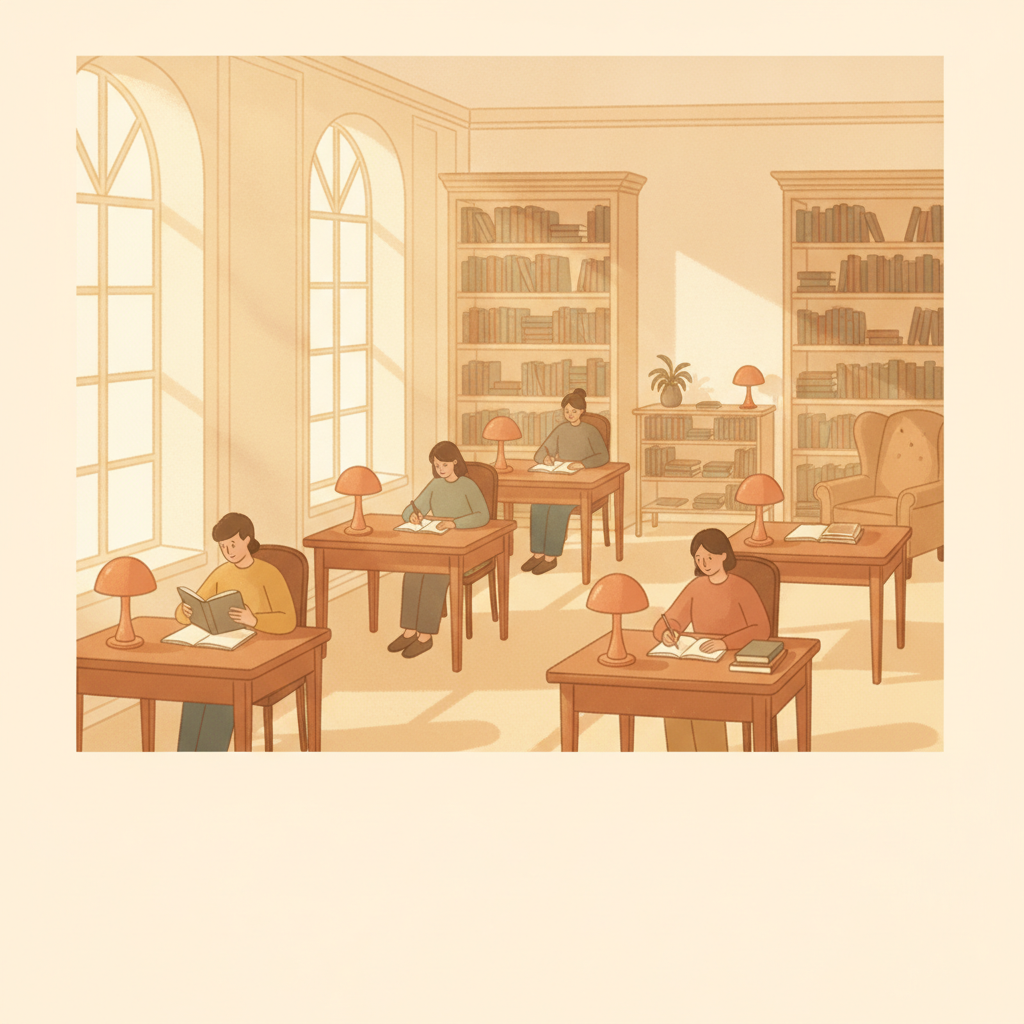
The library got you through finals. Not because it had books. Your dorm had books. The library had people. People working, quietly, all around you, all silently agreeing that this was a place where you do the thing. You borrowed that agreement. It carried you.
This is also exactly why “study with me” videos and Sunday reset streams quietly exploded. Millions of people put a stranger on a screen in the corner of their vision so they could borrow a little presence. People are not doing that because it is trendy. They are doing it because it works, and because somewhere along the way the rooms disappeared from their lives and they went looking for a replacement.
That is the real story of the last few years. We optimized ourselves into rooms of one. We work from home, alone. We study from home, alone. We run our side projects at midnight, alone. And then we are confused and ashamed that focus got harder, as if the brain were supposed to be unaffected by the fact that we removed the single most reliable focus tool humans have ever had: other people.
What this is not
I want to be honest, because the anti-shame version of this idea is only useful if it is also true.
Presence does not help with everything. The same research that says you are faster at simple tasks around others also says you can be worse at genuinely hard, brand-new, high-stakes tasks when people are around, especially if you feel watched. Writing the scariest paragraph of the hard thing might still need a closed door. Learning something truly unfamiliar for the first time might need quiet and solitude.
So this is not “always work around people.” It is more specific and more useful than that.
For the pile of simple, well-learned, avoided things that quietly run your life, the dishes and the email and the form and the cleanup and the admin, a room of other people working is one of the most reliable levers you have. It is the lever the discipline talk completely ignores, because the discipline talk is too busy telling you that the pile is a moral failing.
It is not a moral failing. It is a missing room.
The room is a thing you can choose
Here is the part that should feel like relief.
If focus is environmental, then it is solvable in a way that “be a better person” never was. You cannot install discipline. People have been trying to sell you that download for your whole life and it has never once worked, because there was never a file there to download. But you can absolutely change your environment. You can put yourself in a room.
For some people the room is easy. They have a coworking space down the street, or an office that still has people in it, or a friend who is always free to cowork at 10am. Lucky them. The room is right there.
For a lot of us, though, the room got expensive or inconvenient or both. The coffee shop is a forty-minute round trip and a five-dollar entry fee per visit. The coworking membership is a monthly bill you cannot justify for something you would use twice a week. And scheduling a focus call with a friend means coordinating two chaotic calendars, which is its own avoided task.
This is the gap we built Task Party to close.
Task Party is the room, on demand
Task Party is a focus room you can drop into without leaving the house and without booking a friend. A host opens a session. You join. You set one goal, the thing you are actually here to do. Then you work your list alongside other people who are doing the same, on camera or off, in companionable quiet. You check in at the start and check out at the end. That is it. That is the whole magic, and it is the same magic the library always had: a room of people who have all silently agreed that right now, we work.
It is the library effect, the coffee-shop effect, the call-with-a-friend effect, packaged so you can summon it in two minutes instead of building it from scratch every time.
The format is not new. Flow Club proved people want a hosted focus room, and it is good. But it sits behind around forty dollars a month, and it leans into a hustle energy that does not fit everyone. We took the part that works, the room, and made two deliberate choices. We made it warm instead of intense, because shame is not a productivity strategy and you do not need to be yelled at, you need to be accompanied. And we made it genuinely affordable, a small fraction of what the premium options charge, because the whole point is that a room of people should not be a luxury good. The room is the most human focus tool there is. It should not be priced like a status symbol.
If you have ever hosted a study group, run a coworking call, or been the friend who somehow makes everyone else productive just by being in the meeting, you might be a founding host, the person who literally creates the room other people have been missing. That is the most generous thing you can do for someone right now: be the reason they finally started.
So stop trying to focus alone
You are not lazy. You are not broken. You are not missing some discipline gene that the productive people were born with.
You are a social animal who keeps trying to do a social thing alone, and then blaming your character when it does not work. The fix is not a harder version of you. The fix is a room. Other people, quietly working, lending you the activation your brain was always built to borrow.
The room does the work that willpower was never going to do by itself. You just have to be in it.
We are building that room, and we are keeping it warm and keeping it cheap. If that is the missing condition you have been beating yourself up over, come join the waitlist. The next time you cannot start, you will not need more discipline. You will just need to open the door and sit down with everyone else who showed up to do their thing too.
Make tasks a party, not a punishment. Bring your doom pile. We will all be right there with you.